 Discuss a partnership
Technology
Fast neutrons open a different production pathway
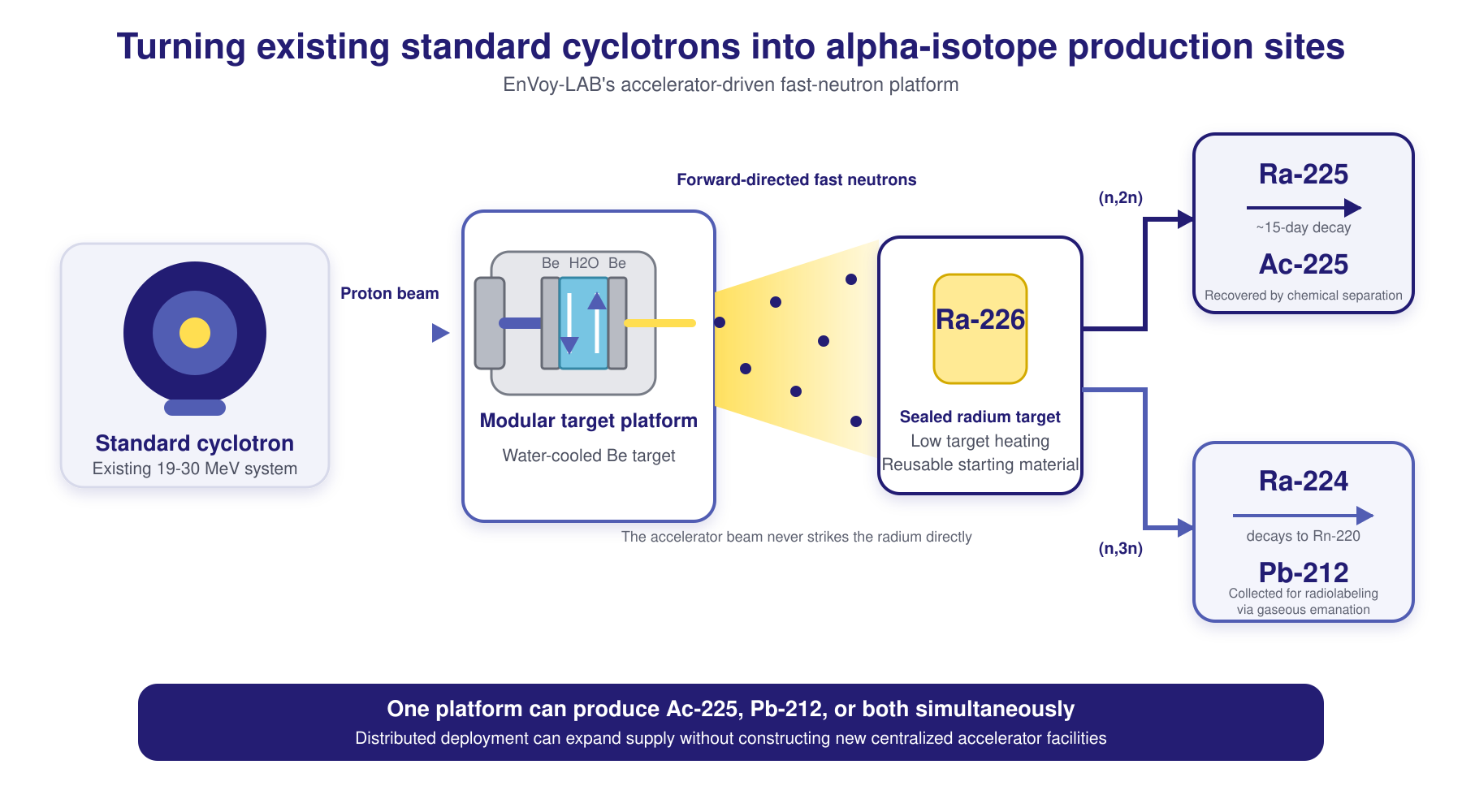
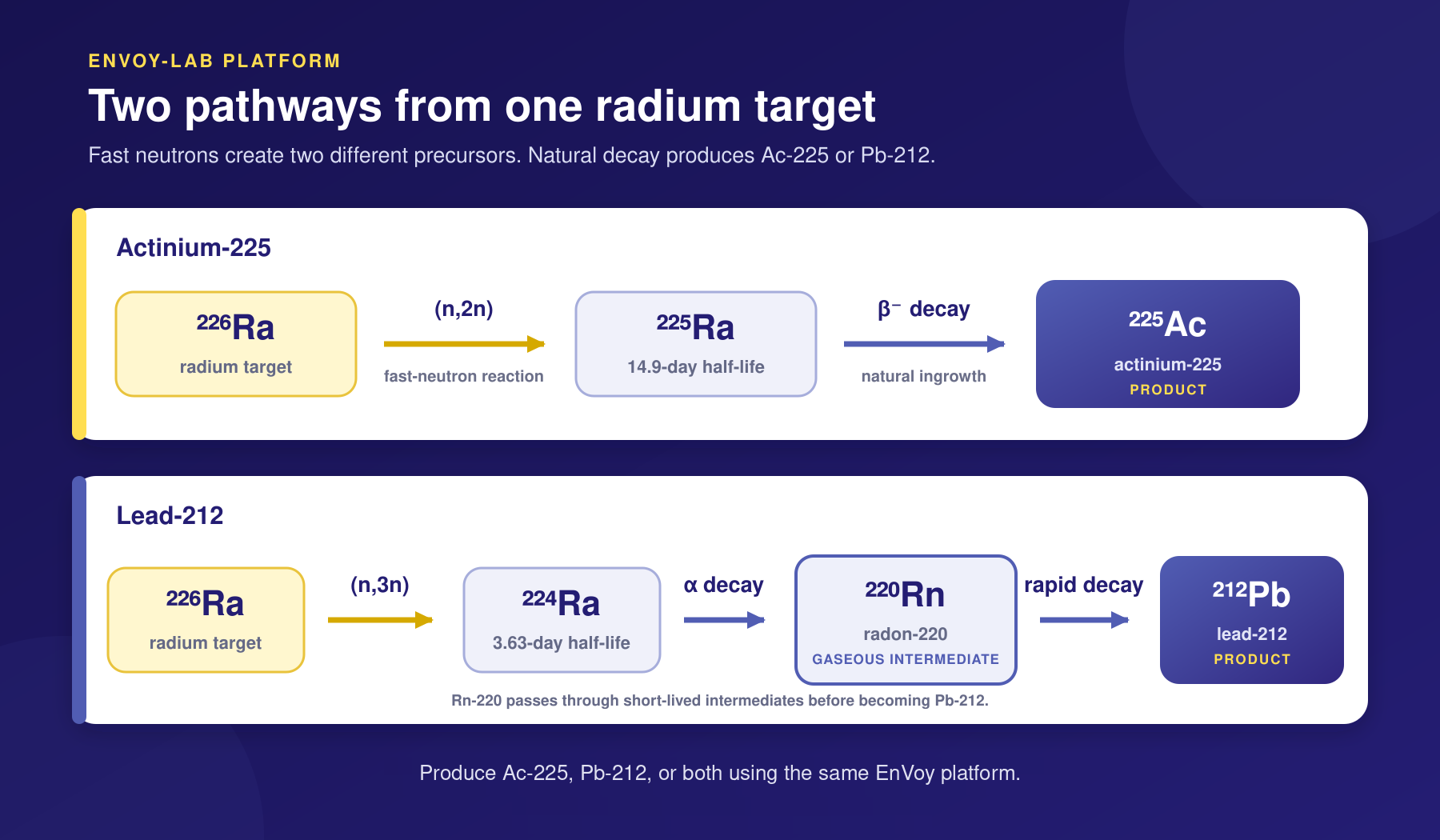
In the EnVoy‑LAB platform, a proton beam strikes a proprietary water‑cooled beryllium target, generating energetic neutrons that irradiate a sealed radium‑226 target. The neutron reactions produce radium‑225, which decays to Ac‑225, and radium‑224, which decays through gaseous radon‑220 to Pb‑212. Ac‑225 is recovered through chemical separation. For Pb‑212, EnVoy‑LAB’s cyclic gaseous‑separation system collects radon‑220 in alternating cold traps, allows it to decay, removes longer‑lived radon‑222, and allows the harvest of pure Pb‑212 directly in a radiolabeling‑compatible solution.
Why it matters
Why indirect neutron irradiation matters
This separation of the proton beam from the radium is important. Direct irradiation of radium with charged particles substantially heats the radium, creating difficult engineering and safety challenges, and adding operational risk to a supply chain where resilience matters most. Patients’ lives are literally dependent upon reliable access. Neutrons, by contrast, can produce the desired nuclear reactions without heating the radium. This approach also critically avoids fission and the formation of long‑lived, detrimental actinium‑227 and other undesirable contaminants unfortunately created by most competing production routes.
Platform breadth
Beyond Ac‑225 and Pb‑212
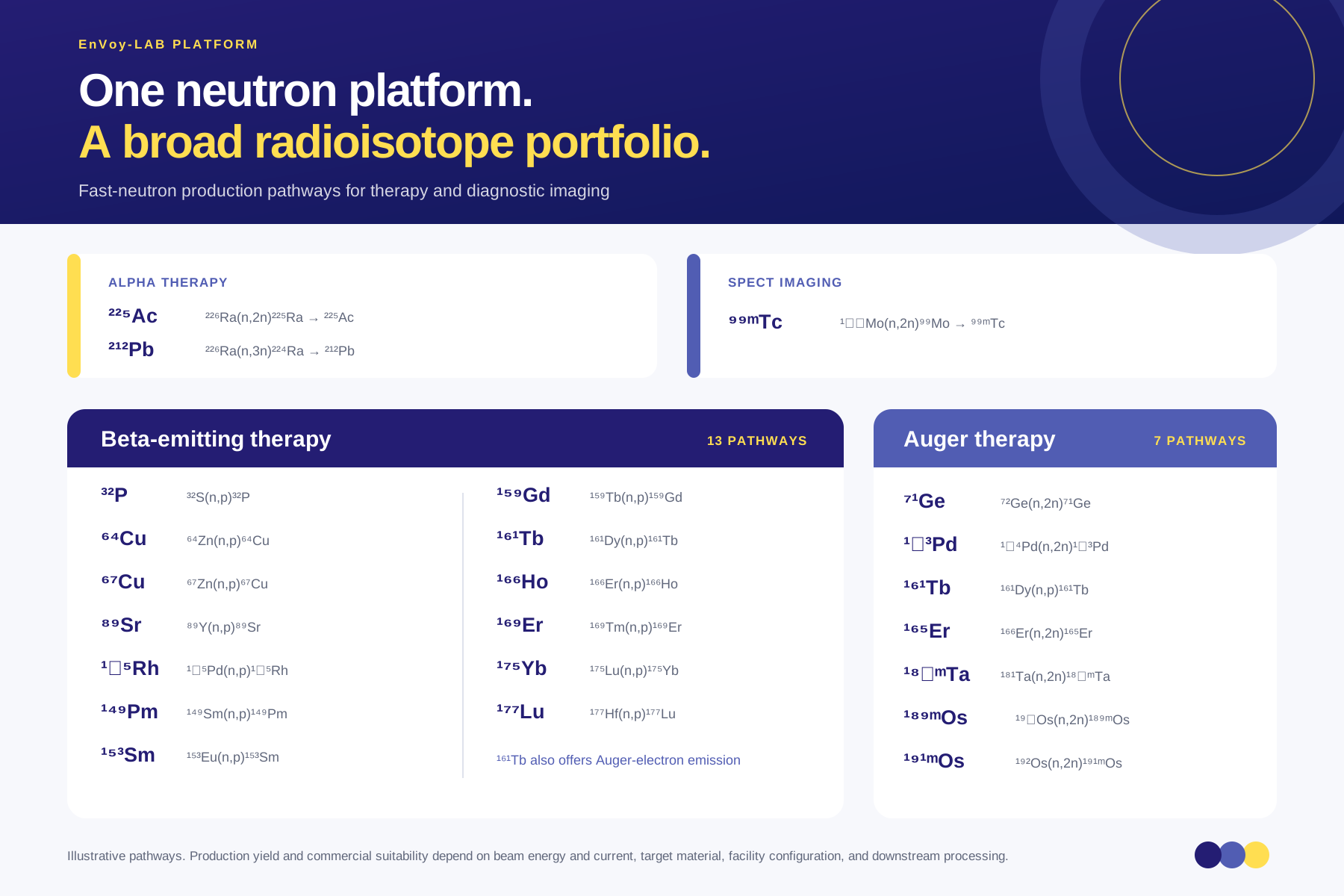
Ac‑225 and Pb‑212 remain EnVoy’s primary commercial focus and require cyclotrons operating at 19 MeV or above for commercially meaningful production. On cyclotrons operating at energies as low as 16 MeV, the same fast‑neutron platform can also open simultaneous production pathways to medically important radionuclides for beta and Auger therapies, as well as PET and SPECT imaging. This gives production partners a flexible platform that can support additional programs as isotope demand evolves. Our team also offers the tacit knowledge to work with partners in adapting our platform to support many emerging radioisotopes already under exploration.
Demonstrated production and continuing optimization
Experiments at Lawrence Berkeley National Laboratory’s 88‑Inch Cyclotron demonstrated the successful production of both radioisotopes. EnVoy has since optimized the neutron‑production target, benchmarked neutron spectra, and continued improving yields.
Discuss your cyclotron and facility